I love lists. The organizing and prioritizing of important information makes my brain do a little happy dance. In addition to tracking the books I’ve enjoyed, I also keep a short list of books I wish I hadn’t read. Recently, I realized that all the books on that list (to be fair, there are only five so far) are classified within the Splatterpunk subgenre of horror. These are books that, for whatever reason, I decided I couldn’t DNF. Maybe I had already invested too much time, maybe I thought the story was going somewhere until it wasn’t, or maybe I was just too stubborn—and it was a short read. Whatever the case, it got me thinking about why so many books in this subgenre (which I promise I like!) have ended up on my list.
A Note About Splatterpunk…
Coined in the 1980s, the term Splatterpunk refers to books that do not shy away from gore, stomach-churning situations, and the depths of human depravity. As the “punk” suggests, it was a subversive reaction to softer horror literature—stories heavy on ghosts and things that go bump in the night. And let me tell you, when I realized Splatterpunk was a thing, I was on board. I’ve loved gory, ruthless movies since the moment my young eyes lit up the first time I watched Saw. You mean to tell me there are books out there that do the same thing? Score!
Since watching John Kramer rise bloody from the floor of that disgusting bathroom as Adam looked on in horror, I have consumed an actual ton of depraved films and literature—many of which I’ve enjoyed, and some I wish I hadn’t finished. I say all this to get ahead of that familiar refrain often sung by diehard Splatterpunk fans when you dare to question the merit of a particular example:
“You just couldn’t handle it.”
I promise, there are no pearl-clutchers in this house. Is this the part where I hand over my A Serbian Film clout card? I am three Human Centipede movies deep at this point. Nothing shocks me anymore, and I’m probably dead inside, having done irreparable damage to my psyche. So no part of this review—or my criticism of a certain type of Splatterpunk book—comes from a reaction like, “Ew! That’s so disgusting! I can’t believe he wrote that. I’m giving this one star!”
Have we gotten that out of the way? Then let’s proceed.
Some Splatterpunk Books Are Literary Magic
If you’re curious about my personal example of a Splatterpunk book that really knocks it out of the park, see my review of The Girl Next Door by Jack Ketchum. Not only is it chilling to learn that the case was based on a true story, but Ketchum’s mastery of language and his ability to turn the reader into a willing participant in the story are unreal. There is a purpose to the grotesque violence and an ending that pulls no punches.
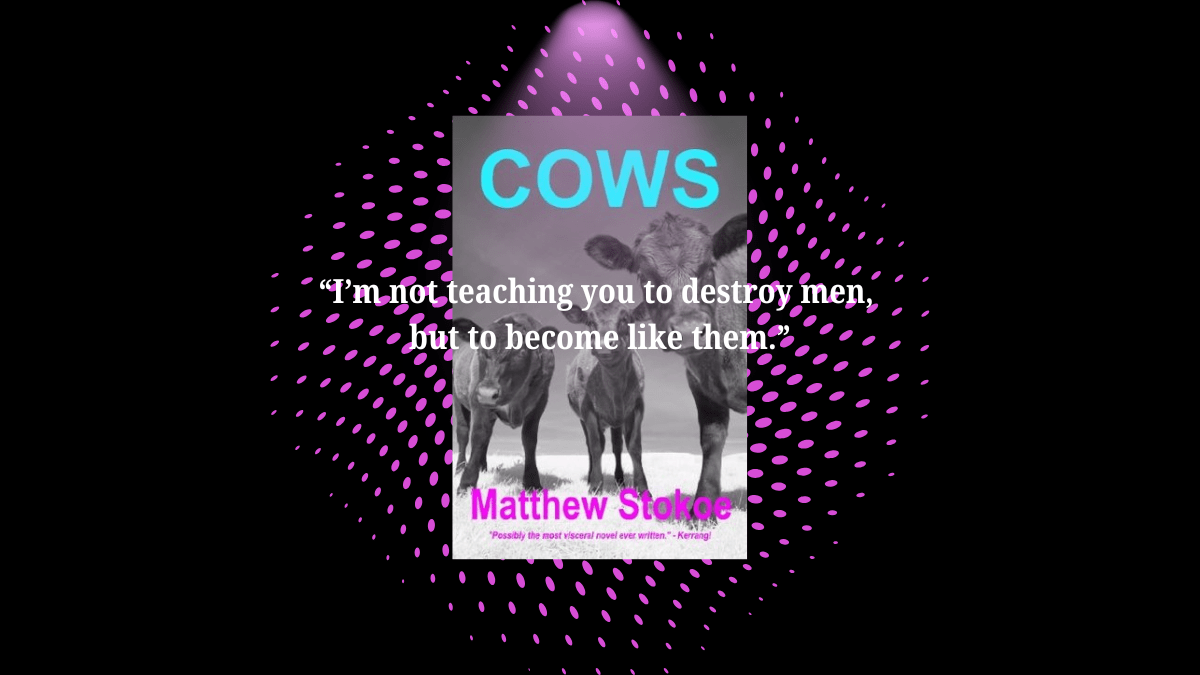
Cows, by Matthew Stokoe…is not that.
I went into this book knowing nothing about it other than seeing it constantly pop up on various “worst of the worst” lists—and there’s no faster way to intrigue me than that.
The story follows Steven, a low-level slaughterhouse employee who has been abused by his mother his whole life. I was immediately reminded of Tender Is the Flesh by Agustina Bazterrica and couldn’t wait to find out what this strange slaughterhouse world had in store. As I continued, however, I noticed there wasn’t a unique central idea pulling me in (like the concept of humans being slaughtered for food in Bazterrica’s novel), at least not at first.
The first third of the book focuses on Steven’s ghoulish workplace and his relationship with his gruesome mother, both of which are so outrageously vile that they strain credulity. Steven has no bond with his mother; rage and defeat are his only feelings in her presence. Meanwhile, she is so relentlessly awful that it becomes absurd. She verbally and physically assaults her adult son, forces him to eat disgusting food that makes him sick, tells him he ruined her life and that she wishes she had aborted him in every imaginable way, and abuses the family dog. Oh—and she’d rather eat her son’s feces than give an inch in an argument.
There are no memories of a time before she became this way—no shared moments of warmth or connection. In my opinion, this makes Steven’s decision to kill her unsurprising and inevitable.
The slaughterhouse workers suffer from a similar issue: they are over-the-top cruel and grotesque to the point of absurdity. They perform every act you can imagine to harm the cows—and some you probably couldn’t. Is it gory? Yes. Is it horrific? Also yes. Do any of these characters have redeeming or surprising qualities that make them interesting? Not really.
About halfway through, I started wondering if the story would actually go somewhere. That’s when Steven is visited by cows living beneath the city in an abandoned subway system. They ask for his help in seeking revenge against the head ghoul at the slaughterhouse. Through helping them, Steven begins to find his own sense of power.
From a literary standpoint, I like this. The message Stokoe conveys about isolation and the effects of abuse is powerful—it’s just not particularly engaging to read.
Each of the book’s most grotesque moments, including imagery clearly designed to shock and horrify, is easily predictable given the setup. For example, Steven begins a relationship with a mentally ill woman whom he knows from the start is severely unstable. She becomes obsessed with searching for toxins in the human body, going to extreme lengths to probe herself and cut others open. It’s no surprise, then, when she—growing increasingly depressed during Steven’s long absences—kills herself and their baby during an act of exploratory self-surgery.
You’re tempted to feel for Steven—at least I was—but mostly because of his history with his abusive mother. There is little warmth or love between him and his girlfriend. She functions more as a prop for both Steven and Stokoe than as a fully realized character.
That’s not to say the book has nothing going for it.
Stokoe’s linguistic style occasionally transforms horrifying imagery into something tragically beautiful:
“He was adrift in their world, unsure of his significance, and to open himself to a point where conversation could take place would only have revealed how unlike them he was.”
The recurring theme of Steven imagining his life based on the kinds of lives he sees on TV provides one of the few genuine emotional gut punches in the book. And the introduction of the subway cows almost feels like the start of a different novel—which, in this case, helps carry the reader through the remainder of the story.
While I’ve been critical of Stokoe’s novel, it’s not nearly as egregious as some other Splatterpunk works in its fixation on shock value at the expense of story. There is a story here—and a message—which is more than I can say for many books in this genre. I just wish he had taken the same care in developing his characters as he did in reinforcing his themes.
What should I read next? Leave your suggestion below!

