
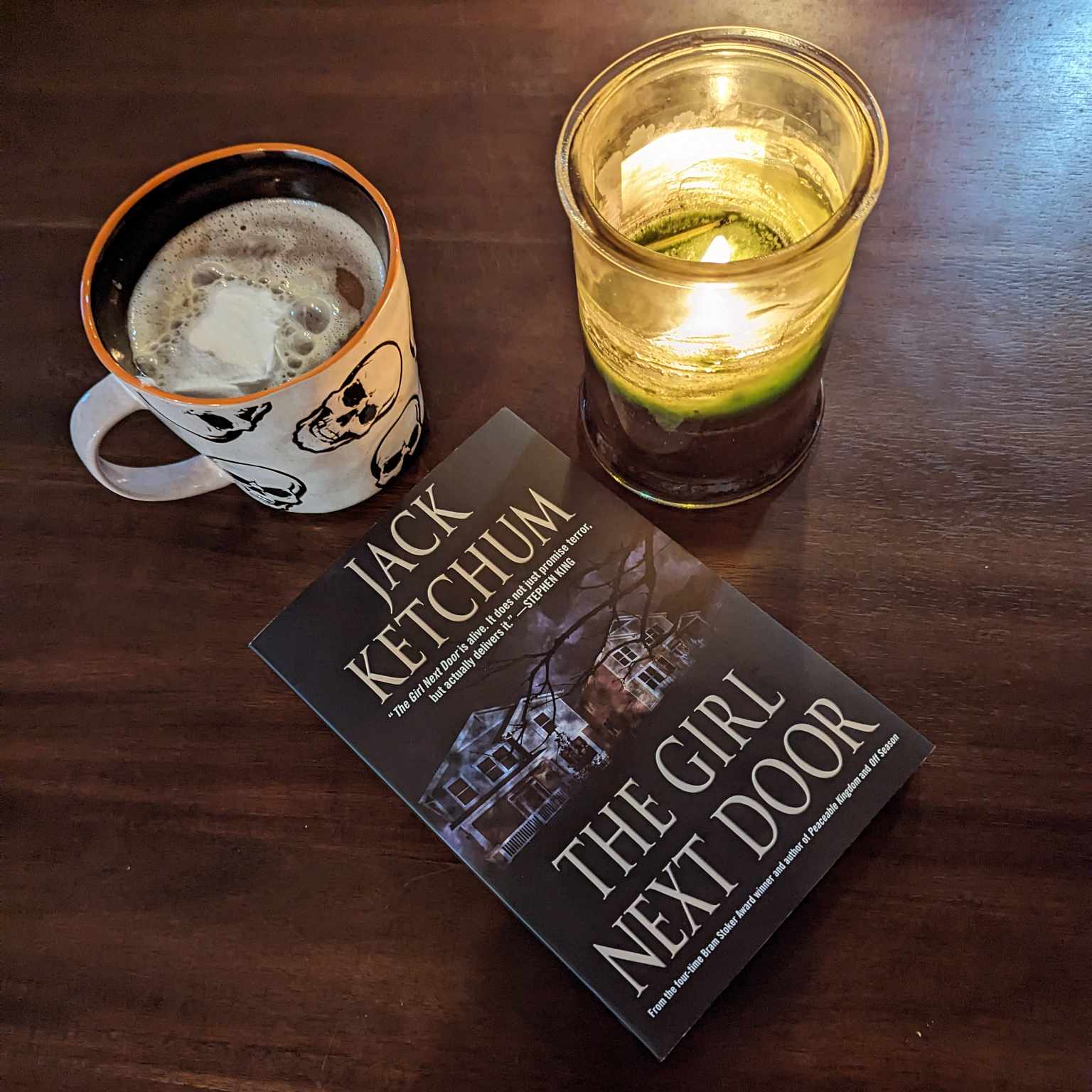

– SPOILERS! –
The Girl Next Door by Jack Ketchum is the story of Meg Loughlin and the abuse she suffers at the hands of not only her caretaker and aunt Ruth Chandler but Chandler’s children and a group of neighborhood kids she allows to join in. She is locked in a basement indefinitely and subsequently chained, gagged, blindfolded, beaten, assaulted, raped, burned, and ultimately mutilated until her death. Sounds lovely, doesn’t it?
In seriousness though, it has easily carved itself a place in my top five favorite books of all time. It expands the traditional definition of horror by shining a glaring light on the depths of human depravity. There are no jump scares in this book. No monsters waiting around the corner. But don’t believe for a second that you’ll sleep well after finishing it. The story explores themes of culpability, loss of innocence, and adult/child dynamics from a twisted, “coming of age” perspective.
“You think you know about pain?”
That’s the first question our protagonist David Moran asks us, the readers, as we begin the book. It’s more of an accusation. Do we think we know how bad it can get? David’s going to show us. This is his cautionary tale, but in my opinion, David’s end goal in telling us this story is unclear. At times it seems he simply wants us to learn from his mistakes, to do right where he went so, so wrong. However, there are other moments throughout the book that might suggest we’re working with a somewhat unreliable narrator. He’s sharing a lot with us, but he also desperately wants to assuage some of that deep guilt he’s been carrying and absolve himself of some of his sins. You be the judge of whether or not he’s successful at that.
An interview with author Jack Ketchum in the back of my copy shares his motivation for writing this story in the first person tense. When you read a book the narrator’s voice becomes your voice – the voice in your head. We’re David. We’re culpable simply by continuing to turn the page. We’re in the room watching Ruth torture Meg Loughlin. Are we going to intercede? Put the book down? How responsible are we for what happens to her in the end?
Without outright saying it, David sort of presents the idea that the stage was perfectly set for Meg’s ultimate outcome from the outset. The group of neighborhood kids is used to playing a disturbing children’s activity simply called – The Game. At the end of each session of which one kid is tied to a tree and tormented for hours, sometimes naked. This is one of those instances that feels unsettling to read about, but also one that the readers can hand-wave away as an activity that simply got out of hand without adult supervision. Something that could have happened to any of us as kids. And we certainly didn’t all turn out to be murderers.
The reason for The Game’s transformation from a chance to pelt your friends with apples to an opportunity to perform more insidious acts? Hormones. The introduction of a girl, Eddie’s sister Denise, changes everything and suddenly there is a loss of innocence that informs the rest of the story. That loss of innocence, coupled with the permission the boys receive from Ruth, is all the excuse they need to slide certain behaviors from the “Not Okay” to the “Okay” category in their minds. New mission unlocked.
Ruth’s permission is a crucial element of the narrative and just one of the ways in which the power dynamics between adults and children (particularly in the 1950s) are explored. Early on Ruth enlists her sons, as well as the neighborhood boys, to burn sacks of tree worms out of the trees in her yard. First, let’s just stop and appreciate the imagery of these tween boys lit-er-ally carrying torches for her. Ruth’s the cool mom. She smokes, swears, gives away beers, and never wears a bra. Hers is the house that all the neighborhood kids flock to and why shouldn’t they? She may be more relaxed than most parents, but she’s still a parent after all, right? In the end, no matter how cool she is, the kids are still trusting her to know how far is too far. What happens when the adult in the room is unable or unwilling to set the boundary or say when enough is enough? That’s how David can get away with feeling like-
“Fuck it, let’s see where it goes.”
On the one hand, children in the 1950s were entrusted with more freedom and responsibility than we typically allow them now. David, for example, was pretty young for being tasked with things like cleaning the grill at his father’s bar and running around the neighborhood/visiting the river on his own. However, it could also be argued that they were more infantilized than children today. David’s history with The Game, his raging hormones and desire to see a naked girl, the peer pressure from his friends, and general curiosity all seem to work against him in terms of making up his own mind about this situation. Luckily he doesn’t have to. Ruth’s the adult. She will make up his mind for him.
“In the basement, with Ruth, I began to learn that anger, hate, fear, and loneliness are all one button awaiting the touch of just a single finger to set them blazing toward destruction. And I learned that they can taste like winning.”
It’s interesting to pick up this book, years after its publication, and view it from an incredibly different point of view. You’d have to ask my kids to know for sure, but it seems that a major difference between then versus now is the extent to which kids are treated as people. From David’s perspective in the 1950s, children belonged to their parents. You were property until you weren’t and your opinion didn’t matter.
“Kids were powerless. Almost by definition. Kids were supposed to endure humiliation, or run away from it. If you protested, it had to be oblique. You ran into your room and slammed the door…What you did not do was stand up to an adult and say go fuck yourself, in so many words.”
Like some of the best horror film directors, Ketchum restrains himself from laying out all of the terror at our feet and instead trusts us to create some of it in our minds. At the pinnacle of the book, chapter forty-two, David refuses to share the details of the most horrific abuse Ruth inflicts upon Meg and instead causes us to have to imagine it.
The book is based on the true story of Sylvia Likens, a young woman who was tortured by her caretaker. One extra thing I’m thankful for is the end that Ketchum graced us with. The real-life perpetrator, Gertrude Baniszewski, was convicted of her crimes but didn’t spend long enough in prison, dying of lung cancer only five years after her release. Personally, I’ll take Gertrude’s (Ruth’s) fictional end where David backhands her down a flight of steps and she snaps her neck after shitting herself. This was extremely satisfying to read after knowing the real story and I appreciate Ketchum for this little gift waiting at the end of a truly harrowing book – one that I can’t recommend enough.
 briennedaugherty.com